Agrorami: a B2B platform for the agricultural sector
About
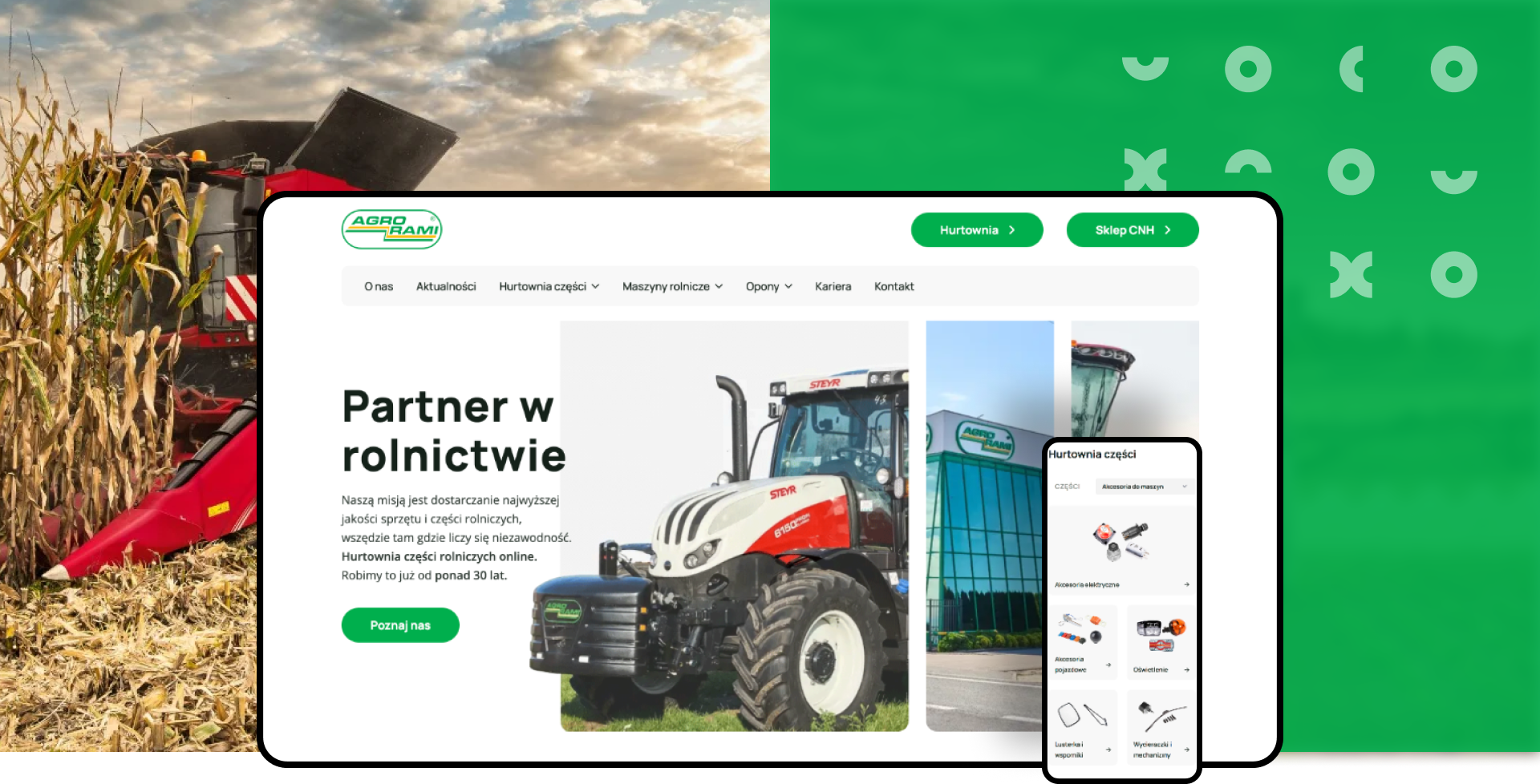
Strix helped Agrorami organise its online sales and implement a new platform based on B2B Box, tailored to the real purchasing processes of business customers.
Challenge
Agrorami is a brand operating in the agricultural machinery parts and accessories sector. Its customers are primarily companies, service centres, stores and professional users for whom the purchasing process depends on several key factors: quickly finding the right part, product availability, accurate pricing, the ability to reorder products and efficient handling of a large technical catalogue.
The company already had its own B2B solution, but over time it became difficult to scale further. Strix helped Agrorami organise its online sales and implement a new platform based on B2B Box, tailored to the real purchasing processes of business customers.
Limitations of the existing B2B platform
Agrorami had previously used its own custom-built B2B solution. The platform met the needs of a narrow group of customers, but over time it began to limit the further development of online sales.
The system had been heavily customised for specific cases and the individual needs of selected customers. This approach worked at the initial stage, but made it difficult to standardise processes and scale the platform to a larger customer base.
The key challenge was to create a platform that would not only support sales, but also strengthen digital operations: serve a larger number of customers, organise purchasing processes and give the company a solid foundation for further growth.
The need to standardise sales processes
In B2B, especially in the trade of technical parts, sales are often based on relationships, individual commercial terms, price lists, discounts and the handling of recurring orders.
Agrorami needed to reflect these processes in a structured way, without having to create dedicated workarounds for individual customers each time.
It was important to support, among other things:
- individual price lists and customer groups,
- credit limits,
- product availability, including backorders, i.e. orders for goods available from manufacturers despite not currently being in Agrorami’s warehouse,
- multipacks and packaging rules,
- commercial document history,
- fast order placement,
- cart import from files,
- multiple users within a single company account.
A complex catalogue of technical products
Selling agricultural machinery parts is different from typical B2C e-commerce. Customers are not looking for inspirational product descriptions or extensive lifestyle content. Most often, they already know which part they need, know the product code or manufacturer’s number, or are looking for a replacement.
At the same time, technical product catalogues can be difficult to organise. Data provided by manufacturers is often limited, tabular and lacks extensive descriptions. That is why an important part of the project was integrating the platform with a PIM system, which supported product data management, data organisation and the creation of relationships between products, including replacements and complementary products.
The platform therefore had to do more than simply present the catalogue. It had to use the data prepared in the PIM in such a way that users could quickly find the right part, even when the product data was technical and limited in nature.
Security and roles on the B2B customer side
At an earlier stage, business customers often used shared accounts. In practice, this meant that different people within one company could work using the same login, without a clear division of roles and permissions.
For B2B customers who work as teams, place orders on behalf of a company and need control over the purchasing process, this solution was insufficient.
Agrorami needed a more professional company account structure that could reflect the real way organisations work: different people, different roles and different levels of access.
Integrations as a condition for stable operations
Integrations with external systems, primarily ERP and PIM, were a key element of the project. The B2B platform had to operate as part of a larger ecosystem, not as a separate online store.
The most important data, such as prices, stock levels, credit limits and commercial documents, had to be retrieved from source systems. The ERP system remained the source of truth for sales processes, while the B2B platform was designed to present this information to customers and enable convenient online ordering.
Solution
Implementation of a B2B platform based on B2B Box
Strix implemented a B2B platform for Agrorami based on B2B Box and built on Magento. It is a predefined B2B sales system enhanced with proven market modules and Strix’s proprietary functionalities, created on the basis of experience from multiple B2B e-commerce implementations.
B2B Box addresses the recurring needs of companies selling in a business model, such as company accounts, user roles, individual price lists, cart, checkout, quick orders, purchase history and integrations with external systems. As a result, the team did not have to design the core B2B sales mechanisms from scratch and could instead focus on adapting the platform to the specifics of Agrorami’s business.
At the same time, B2B Box is not a closed, rigid product. It is a flexible foundation that can be adapted to the processes of a specific company, the characteristics of the industry and unique purchasing scenarios. In Agrorami’s case, this made it possible to shorten the implementation time, reduce project risk and create a platform ready for further development in subsequent stages.
Individual price lists and commercial terms
One of the key elements of the implementation was reflecting individual B2B sales terms.
The platform supports customer groups and price lists assigned to them. This allows Agrorami to standardise commercial terms for specific customer segments while still retaining the ability to handle exceptions and individual business arrangements.
Price lists, product availability and other commercial data are fed from the ERP system, which helps maintain consistency between the B2B platform and the company’s operational backend.
Company accounts, roles and permissions
The new platform enables the creation of company accounts with multiple users, as well as the definition of roles and permissions.
This allows Agrorami’s customers to better reflect their own organisational structure. Within one company, several people can use the platform, for example an employee responsible for orders, a decision-maker or the accounting department. Each of them can have different permissions assigned.
This is an important change compared with the model in which the entire company used one shared account. The new solution improves security, structures the purchasing process and better meets the needs of professional B2B customers.
Quick orders, cart import and repeat purchases
In B2B sales, the speed of placing orders is crucial. Agrorami’s customers often order products repeatedly, work with parts lists or prepare larger orders in files.
That is why the platform was equipped with functions supporting fast purchasing:
- cart import from a file,
- quick order,
- reordering previous purchases,
- shopping lists,
- multiple wishlists,
- multiple carts,
- the ability to work on several carts in parallel.
Multiple carts are a particularly important functionality. Within one account, a user can store several carts and switch between them smoothly. This allows the customer’s employees to aggregate several carts for their own end customers or prepare separate carts for different operational needs, and then process them independently.
This solution fits the way B2B customers work. They often complete orders in stages, handle several enquiries at the same time or want to keep a previously prepared cart without having to finalise it immediately.
Search tailored to a technical parts catalogue
Particular emphasis was placed on product search. In this sector, B2B customers often do not browse the catalogue for inspiration, but search for a specific part, manufacturer number, SKU or replacement.
The platform enables searching by codes and manufacturer numbers, as well as displaying related products, replacements and complementary products.
In addition, an advanced search engine based on gradual selection narrowing was implemented. Users can select the machine type, brand and model, and on this basis reach the relevant parts. This solution is especially important in an industry where choosing the right product directly affects the work of service centres and end customers.
Integrations with ERP, PIM and warehouse systems
The platform was integrated with Agrorami’s key systems. The ERP system is responsible for commercial data such as prices, availability, credit limits and documents. The PIM system supports product catalogue management and relationships between products.
An important assumption was to preserve the responsibility of individual systems. The B2B platform was not intended to replace the ERP or PIM, but to use the data provided by these systems and present it to customers in a convenient way.
This approach helped maintain process stability and reduce the risk of data inconsistency.
Customer panel with commercial documents
An important part of the implementation was organising access to commercial documents. Previously, customers often requested that documents be sent by email, which generated additional work for the Agrorami team and led to a lack of a consistent service standard.
It also happened that the same documents were sent multiple times or ended up in several independent communication paths. This made work more difficult both for sales representatives and for customers in their day-to-day operations.
The new platform allows customers to independently find documents related to the sales process without having to contact their account manager. As a result, the platform does not only serve a purchasing function, but also organises access to information and reduces the number of repetitive enquiries sent to the Agrorami team.
UX refresh and migration to Hyvä
In subsequent development stages, Strix refreshed the platform’s front-end layer, including a migration to Hyvä. The goal was not only to improve the look and feel, but above all to increase platform performance and improve users’ daily work.
This was particularly important when searching listings containing thousands of items, working with carts and placing orders. Thanks to improved performance, users can move through the catalogue faster, find products more efficiently and complete purchases more conveniently in a B2B environment.
Business customers use modern B2C solutions in their everyday lives and expect a similar level of convenience from business tools. The UX refresh helped respond to these expectations more effectively.
Performance optimisation
The platform continued to be developed and optimised after launch. The Strix team worked on improving the performance of individual views, especially when handling large numbers of products and individual prices.
One of the improvements was dynamic price loading on product listings. This allows users to see products faster, while individual prices can be retrieved and displayed without burdening the initial page load.
This is an example of an approach in which technical optimisation has a direct impact on user experience and the efficiency of everyday work with the platform.
Support for mobile work
It was also important to adapt the platform to users working outside the office. In the agricultural sector, some purchasing processes may take place in the field, during a customer visit, on a farm, in a service centre or next to a machine.
The platform supports quick operations on mobile devices, such as checking products, availability and prices, as well as placing orders. This means that sales representatives and customers do not have to postpone simple purchasing activities until they return to a computer.
This is especially important in situations where time and access to up-to-date information matter. Mobile support increases work flexibility and makes it easier to complete orders in everyday B2B operational scenarios.
Results
The implementation for Agrorami shows that effective B2B e-commerce is not only about launching a platform where customers can add products to a cart. In complex technical sales, true value appears when the system reflects real commercial processes, organises data, integrates with the company’s operational backend and makes everyday work easier for both customers and the sales team.
Strix created a platform for Agrorami that combines several key areas in one coherent environment: online sales, individual commercial terms, company accounts, user roles, quick orders, document handling, technical parts search and integrations with ERP and PIM. As a result, the platform is not an add-on to the sales process, but its central digital tool.
The project made it possible to move from a heavily customised solution that was difficult to scale further to a structured B2B system supporting both current customer service and the continued development of the online channel. Agrorami’s customers gained greater independence and more convenient access to information, while the sales team can focus on more complex enquiries, larger customers and activities that require an individual commercial relationship.
An important value of the implementation is also the fact that the platform was adapted to the specifics of the agricultural sector: a broad technical catalogue, work based on product codes, replacements, availability, multiple carts and recurring orders. This is not a generic B2B store, but a solution designed around the real way customers work. They often need to quickly find the right part, confirm purchasing terms and proceed to order without involving additional people.
Thanks to the cooperation with Strix, Agrorami gained a stable foundation for the further development of digital sales: a platform that standardises processes, increases service efficiency, improves the purchasing experience and opens up new opportunities for acquiring customers online. It is an example of an implementation in which technology is not an end in itself, but a tool for scaling the business, building operational advantage and developing B2B sales in a demanding industry.
Thanks to the cooperation with Strix, Agrorami received a solution that:
- standardises sales processes,
- supports business customer service,
- relieves sales representatives of repetitive tasks,
- makes it easier to place orders quickly,
- improves technical product search,
- supports individual commercial terms,
- integrates with the company’s key systems,
- provides a solid foundation for the further development of online sales.
Technology
This project is built with our technology partners:


