Gatta on Shopify Plus: a migration that opened a new stage of e-commerce growth
About
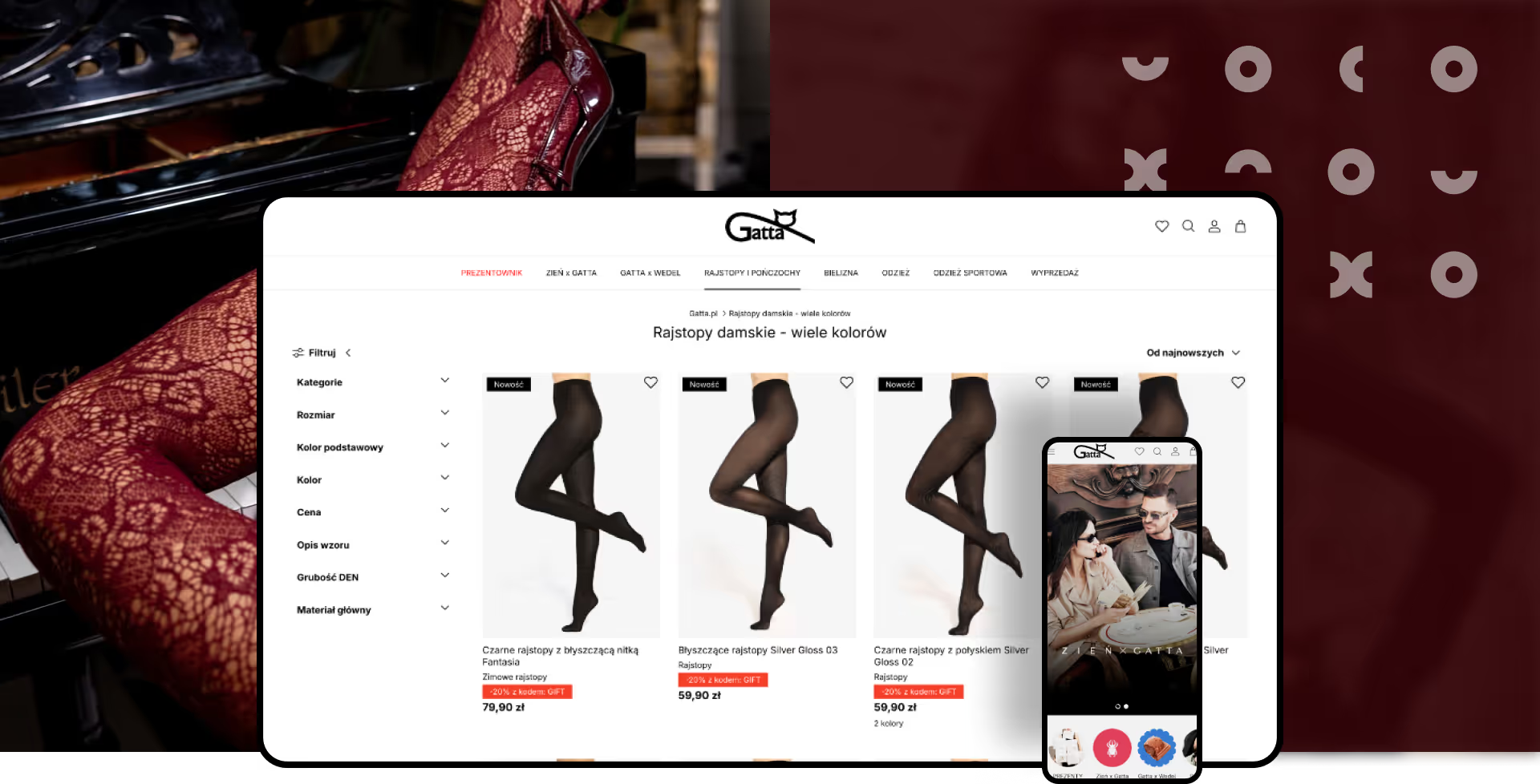
Gatta – a well-known Polish fashion brand (tights, underwear, apparel) – after more than 10 years of developing its e-commerce on a custom-built technological solution, made a strategic decision to migrate its online store to Shopify Plus, treating it as the foundation for the next stage of digital growth.
Challenge
Gatta – a well-known Polish fashion brand (tights, underwear, apparel) – after more than 10 years of developing its e-commerce on a custom-built technological solution, made a strategic decision to migrate its online store to Shopify Plus, treating it as the foundation for the next stage of digital growth.
The brand has been selling online for years, has strong market recognition, and manages a large product catalog. However, it became increasingly clear that their existing tools were no longer keeping pace with the company’s ambitions.
Why Gatta needed a new platform
The starting point was a custom CMS built specifically for the online store. For years it fulfilled its role, but with every passing year it became less flexible in meeting new needs.
The e-commerce team felt this most strongly. The solution that had successfully supported sales for years started to limit their ability to react quickly to changes and to flexibly develop shopping processes - something that became increasingly noticeable as the business scaled. Every new integration effectively meant a small development project “from scratch.”
This challenge was amplified by the scale of the business. Gatta manages tens of thousands of SKUs and highly detailed product pages. Product descriptions must include information about materials, certifications, fabric safety - making product data one of the key areas where the previous system became a bottleneck.
At the same time, the company was evolving its system environment. Ergonode PIM was introduced, the ERP had been running for years, and a robust loyalty program - mostly focused on brick-and-mortar stores - was in place. At a certain point, all these worlds had to be unified into one cohesive e-commerce ecosystem.
Another very practical concern was SEO and visibility in Google. Gatta had spent years building its position, developing a complex URL structure and earning substantial backlink equity. Migrating to a new platform with a different URL logic carried serious risk.
Solution
Implemented solutions – how we built the ecosystem around Shopify
We began the project with the frontend layer, using a theme that:
- provides a modern look and solid UX practices,
- is flexible enough to align with the brand’s character,
- allows Gatta’s internal team to independently build content, banners, and campaign sections.
All design decisions were based on the real needs of Gatta’s primary target audience, with a strong focus on clarity, intuitiveness, and a comfortable shopping experience.
The website was significantly expanded from a content perspective - so to avoid performance degradation, we carried out frontend optimizations: cleaning up sections, reducing unnecessary elements, and fine-tuning resource loading.
Patchworks as the integration backbone
At the heart of the integration architecture is Patchworks - the platform through which all key data flows pass:
- product information and attributes,
- inventory levels,
- orders,
- data for the loyalty system and other services.
Below Patchworks, on the source system level, are:
- ERP Microsoft Dynamics 2009 – a long-standing, critical operational system,
- PIM (Ergonode) – responsible for product catalog and attributes,
- Sparta Loyalty system,
- marketing automation tools and payment/shipping integrations.
For Strix, the key was designing flows that:
- do not overload Patchworks with too many operations (challenging with tens of thousands of SKUs),
- ensure data consistency across all systems,
- simplify logic wherever possible.
Optimizing the data model in PIM
The data model was jointly optimized to fully leverage Shopify’s capabilities while preserving Gatta’s extensive product information structure.
During integration, Strix and Gatta redesigned the division of responsibilities:
- the attribute dictionary (what features a product can have) is maintained in Shopify,
- PIM manages attribute values for each specific product,
- data is synchronized to accurately reflect complex product pages.
This approach proved effective in handling complicated attributes resulting from fabric certifications or safety requirements. It preserved richness and detail without sacrificing performance.
A new life for the loyalty program
The loyalty program required not only integration but also a full rethink of the customer experience. Previously it was heavily offline-oriented: cards purchased in stores, mailed for online use, and discounts verified manually by entering a number.
The new solution connected:
- Sparta Loyalty,
- Patchworks,
- Gadget Dev – a tool enabling dedicated mini-applications inside Shopify.
After implementation:
- customers logging in or entering their email are automatically checked in the loyalty database,
- if they are members, their assigned discounts appear automatically in the cart – no card number required,
- loyalty cards can be purchased online with a faster activation path.
The loyalty program thus became a natural, seamless part of the online shopping experience.
Marketing automation, payments, shipping
In parallel, we configured:
- integration with Samba AI – including module installation, styling adjustments, improved parameter tracking, and implementing Samba AI functionalities in the selected theme,
- payment integrations,
- parcel locker (InPost) module,
- features required by legal regulations, including the Omnibus Directive.
SEO migration – reconciling two worlds
The most sensitive part of the migration was Google visibility. Shopify has its own URL structure rules, which cannot always be aligned with a legacy system’s long-standing URLs. Meanwhile, Gatta had years of SEO investment at stake.
The solution consisted of:
- preparing a new, streamlined URL structure aligned with Shopify,
- mapping old links to their new equivalents,
- implementing a comprehensive redirect mechanism.

Results
What changed for Gatta after migrating to Shopify
From the first days after launch, customers had no difficulty navigating the new environment - despite the substantial changes “under the hood” - and the store began generating sales immediately.
After migrating to Shopify:
- the site runs stably,
- the purchase process is smooth,
- load times and Core Web Vitals scores are very strong,
- SEO visibility and ranking were preserved.
A leap forward in daily team operations
The most noticeable change occurred for the people working with the system every day.
The Gatta team gained:
- full control over orders - the ability to edit them, easy returns handling, better status management,
- more convenient warehouse operations - printing and transferring order summaries directly from the panel,
- simple role and permission management - different teams (e-commerce, marketing, stores) now access only their relevant areas, with user-level change history,
- freedom to build content - banners, sections, and landing pages can now be created and modified independently, without developer involvement.
Operationally, this is a major qualitative shift - the team stops “fighting the tool” and starts using it to bring ideas to life.
A foundation for further growth
The new architecture gives Gatta a solid base on which to safely build future development. It enables scaling e-commerce without “rewriting everything from scratch,” opens the door to new markets, expansion of the B2B channel, or future ERP replacement, and - thanks to clearly defined integration points - makes it easy to extend functionality with new Shopify applications and solutions.
Technology
This project is built with our technology partners: