From 1 to 8 per cent of revenue: how J. König is growing its digital sales with Shopware
About
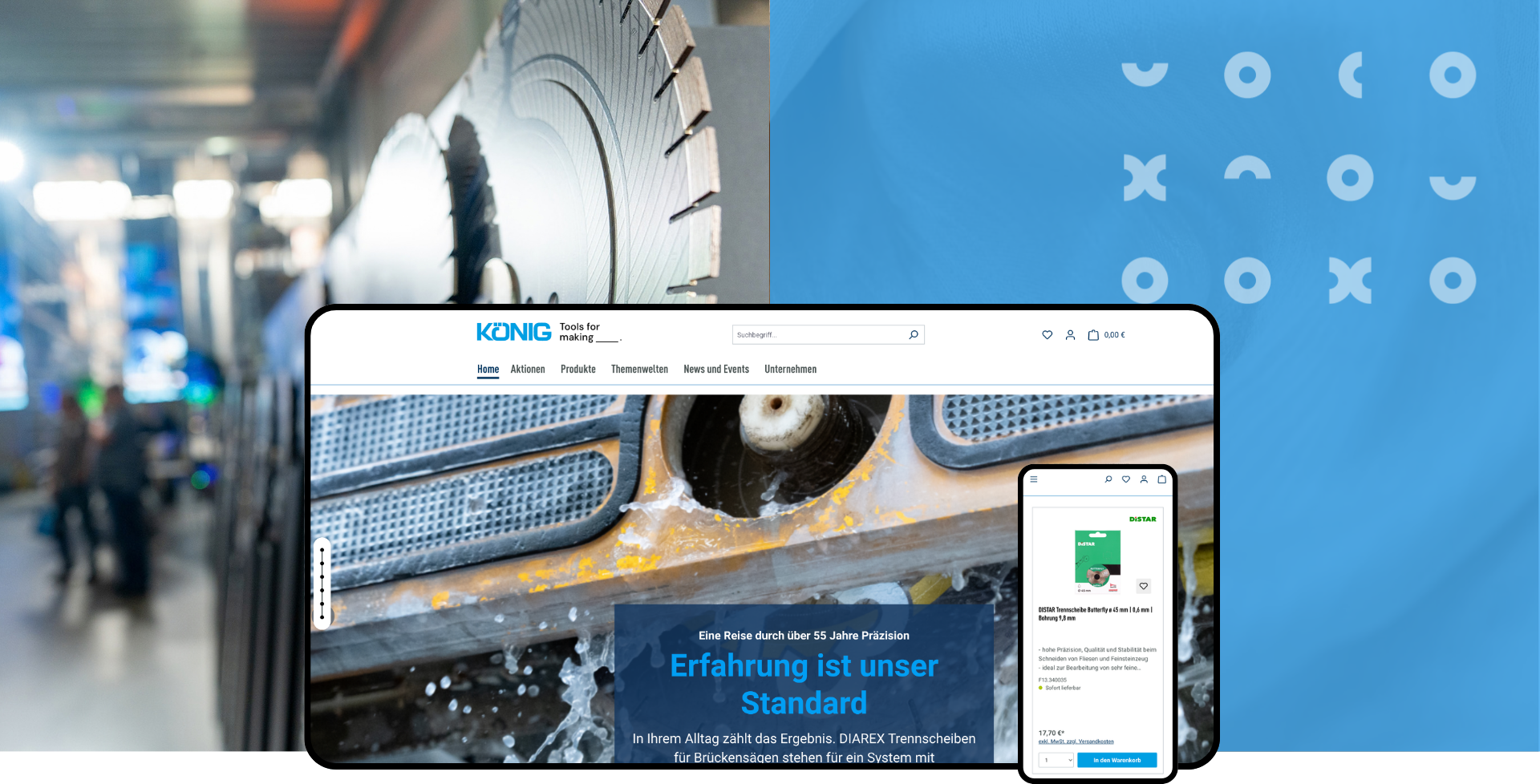
A traditional industry meets e-commerce: our success story shows you how J. König GmbH is using Shopware to transform its online shop from a mere ordering portal into a sales channel.
Challenge
About
For almost 100 years, Karlsruhe-based J. König has stood for tools and solutions for natural stone processing. The company manufactures part of its range in-house and complements it with carefully selected third-party products. Sixteen field sales representatives serve customers across Germany and Switzerland, making traditional direct sales the company's most important revenue channel. At the same time, digital sales keep growing: today, the online shop carries more than 8,000 products and has become a key channel for information and ordering, for customers and employees alike.
Challenge
At some point, somewhere, around 2.5 million years ago, one of our ancestors picked up a stone and began to shape it. He probably had no idea that he was ushering in humanity's very first cultural epoch: the Stone Age.
Tools, weapons, jewellery, later ornaments, statues and entire buildings: stone has been part of our history for as long as we can remember. For millennia, we have been splitting, cutting, hewing, grinding and polishing it. What has changed, above all, are the tools we use to do it.
So when we say that J. König GmbH, as a supplier of tools for natural stone processing, can look back on a long history, we don't just mean the roughly 100 years since the company was founded. We mean practically the entire existence of our species. That said, experience alone is no longer enough to thrive in a traditional industry: tools are becoming ever more specialised, and product ranges ever broader.
Above all, this increases the need for expert advice. Yet while customers expect the best solution for their material and application, they also want ordering to be as effortless as possible.
This success story shows how J. König GmbH is shaping this change and why Shopware plays a central role in it. Our expert guide from J. König is Head of E-Commerce Anatol Menke.
Starting point: proven structures, changing expectations
At J. König, the same holds true as at many companies in a traditional trade: the most important sales channel was, and still is, personal contact. Sixteen field sales representatives look after customers in Germany and Switzerland and generate the lion's share of revenue.
One look at the product range makes it clear why. The right tool depends on the material, the application and the desired result, among other things. In natural stone processing, personal advice is therefore a constant and indispensable part of every purchase.
The old online shop simply couldn't keep up. J. König was using a proprietary solution built on its existing ERP system. Functionality was severely limited, and the store was slow and far from user-friendly. Even basic features such as an order history or the display of product variants were missing.
"You could work with the old shop, but that was about it. For a product range like ours and the expectations of our customers, the solution simply wasn't up to date any more."
Anatol Menke, Head of E-Commerce, J. König GmbH
For a range of more than 8,000 products, which also need to come with technical information, safety data sheets and product and application videos, that is anything but ideal. So it will surprise no one that the online store contributed a mere one per cent of total revenue. But here comes the "but":
The generational shift in B2B is starting to make itself felt
According to Sana Commerce, 71 per cent of the people responsible for B2B purchasing now belong to the Millennial generation or Generation Z: people for whom online shopping has long been second nature. Accordingly, 73 per cent of B2B buyers now prefer to buy online, and according to Gartner, 67 per cent even prefer a buying experience without a sales rep.
That doesn't mean advice is becoming redundant. Quite the opposite: for products that need explaining, expert support remains indispensable. At the same time, the gap between expectations and the digital buying experience is still wide: 89 per cent of B2B buyers in Germany are frustrated when buying online. The most common issues include missing product information and a lack of details on stock levels, delivery times or prices.
"Our customers come from a very traditional industry. But when they shop online in their private lives, they're used to getting information instantly, seeing prices and being able to track their orders. Naturally, they bring those expectations with them into B2B."
Anatol Menke, Head of E-Commerce, J. König GmbH
For J. König, this made the direction clear. The digital presence could not replace the technical depth of B2B sales, but it could complement it with effortless self-service. Customers should be able to find information and place orders on their own, without compromising on the quality of advice.
The existing solution offered no adequate foundation for this. It was time for a complete fresh start.
Solution
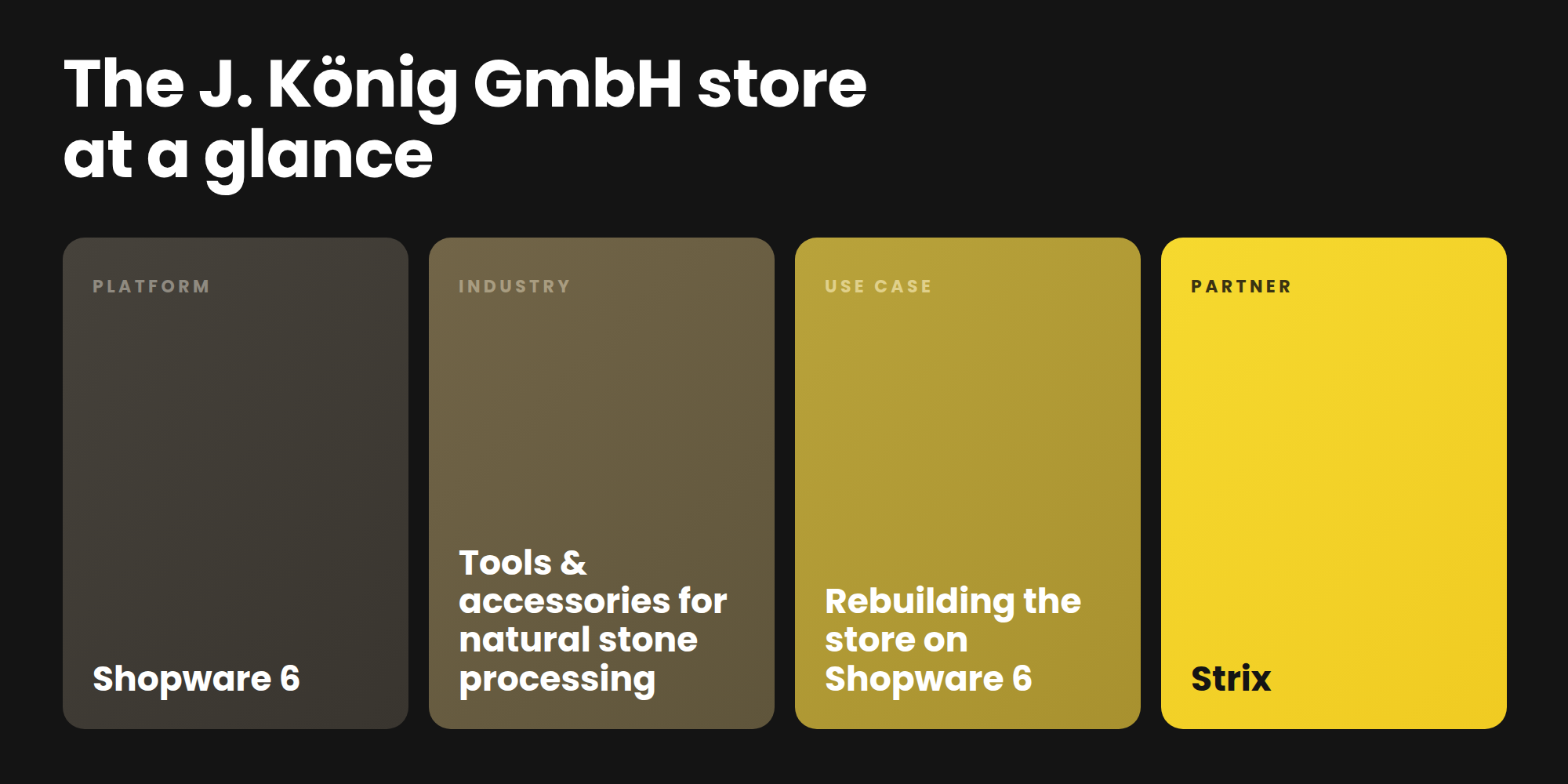
The stated goal of the new build: a platform that could grow with J. König's product range and requirements. In 2020, the company therefore chose Shopware 6 as its shop system and Strix as its implementation partner.
Why Shopware
With more than 8,000 products and extensive product information, J. König first and foremost needed a commerce platform that could reliably handle complex product and pricing structures and provide a modern foundation for the new online shop. Shopware 6 met these requirements and became the basis of the new build.
Why Strix
Choosing a new platform, however, is only half the battle. What tipped the scales in favour of Strix was, above all, the way we communicate. Plenty of agencies can handle the technology. Far fewer can talk straight, bring different perspectives together and stand their ground when problems arise.
"What I particularly value about working with Strix is the open communication. When something isn't working, it isn't hushed up or glossed over. We talk about it, find a solution together and then move the project forward."
Anatol Menke, Head of E-Commerce, J. König GmbH
Even before the project kicked off, it was important to get the IT department, management and other stakeholders on board, and to take their perspectives seriously. After a few meetings, initial reluctance and cautious scepticism soon gave way to enthusiasm and anticipation for the new possibilities.
The guiding principle throughout: be clear about what makes sense, and about which ideas look good on paper but bring no real benefit in day-to-day business. And rather than pretending problems won't happen (every new build has its teething troubles, after all), deal with them the right way: transparently, with a focus on solutions and together with the teams involved.
In traditional industries, business relationships are built on open communication, trust and plain speaking. An agency that prefers to hide behind a glossy façade is usually out of place here.
Implementation: it's all about the people
On the technical side, the fresh start was exactly that: a fresh start. The old proprietary shop was replaced entirely by Shopware 6, and implementation took just six months. There were a few minor stumbling blocks along the way, but these were easily resolved as the project progressed.
The real challenge lay somewhere else entirely. After all, an online shop is only truly successful when it is used not just by customers, but by the company's own people too.
At J. König, this proved especially relevant: here, the field sales team generates most of the revenue and maintains close relationships with customers. The new digital sales channel could therefore under no circumstances give the impression that it was meant to replace personal sales. Instead, the goal was to build acceptance for the new solution.
"We don't want to do away with advice. With our products, advice is extremely important, and for us as a company it's perhaps our most important mark of quality. But when customers know what they need, they shouldn't have to pick up the phone for every order."
Anatol Menke, Head of E-Commerce, J. König GmbH
Anatol Menke therefore focused on showing the field sales team the concrete benefits of the shop in their daily work, and it paid off. Not only did more and more sales reps come on board with the new system, they also grew increasingly comfortable in their new role. Customers can now handle standard orders entirely on their own, which frees up the field sales team's time for what sets them apart day in, day out: advice, problem-solving and introducing new products.
For J. König GmbH, the decisive success factor of the project was therefore a holistic digital transformation. New technology alone achieves little. It only works once the people using it understand the value it brings them.
Results
That leaves the big question: "So, what did it achieve?" For J. König GmbH, success shows not only in rising revenue and order numbers. The store's role within the company has also changed fundamentally.
From sluggish ordering portal to digital showcase
The old proprietary store was slow, offered few features and was a joy to use for neither customers nor employees. It has now become a modern digital hub for J. König. Today, the shop presents more than 8,000 products and brings together technical information, safety data sheets, product and application videos and FAQs.
"For me, the shop has become the brain of the company. It brings together the information our customers need to make their purchasing decisions, and at the same time creates a shared knowledge base for our employees."
Anatol Menke, Head of E-Commerce, J. König GmbH
This makes it far more than just an ordering channel. Customers can explore J. König's product world on their own, while employees know exactly where to find information on a product whenever they need it. This hybrid approach makes the store the pivot point of the entire business.
Acceptance is what counts
The new shop didn't just have to work technically. Above all, it had to be embraced. With the field sales team in particular, that was anything but a given: if you've been looking after your customers personally for years, you need a very good reason to suddenly hand part of your work over to a machine.
This is exactly where J. König started, demonstrating the concrete benefits the shop offers in everyday work: capturing orders directly on site with the customer, reducing follow-up work and accessing up-to-date product information at any time.
The approach paid off. Today, the majority of field sales reps actively use the shop. At the same time, the digital channel has also taken hold with customers: around half of the shop's revenue is now generated without any direct prompt from the field sales team.
From 1 to 8 per cent of total revenue: the shop becomes a true sales channel
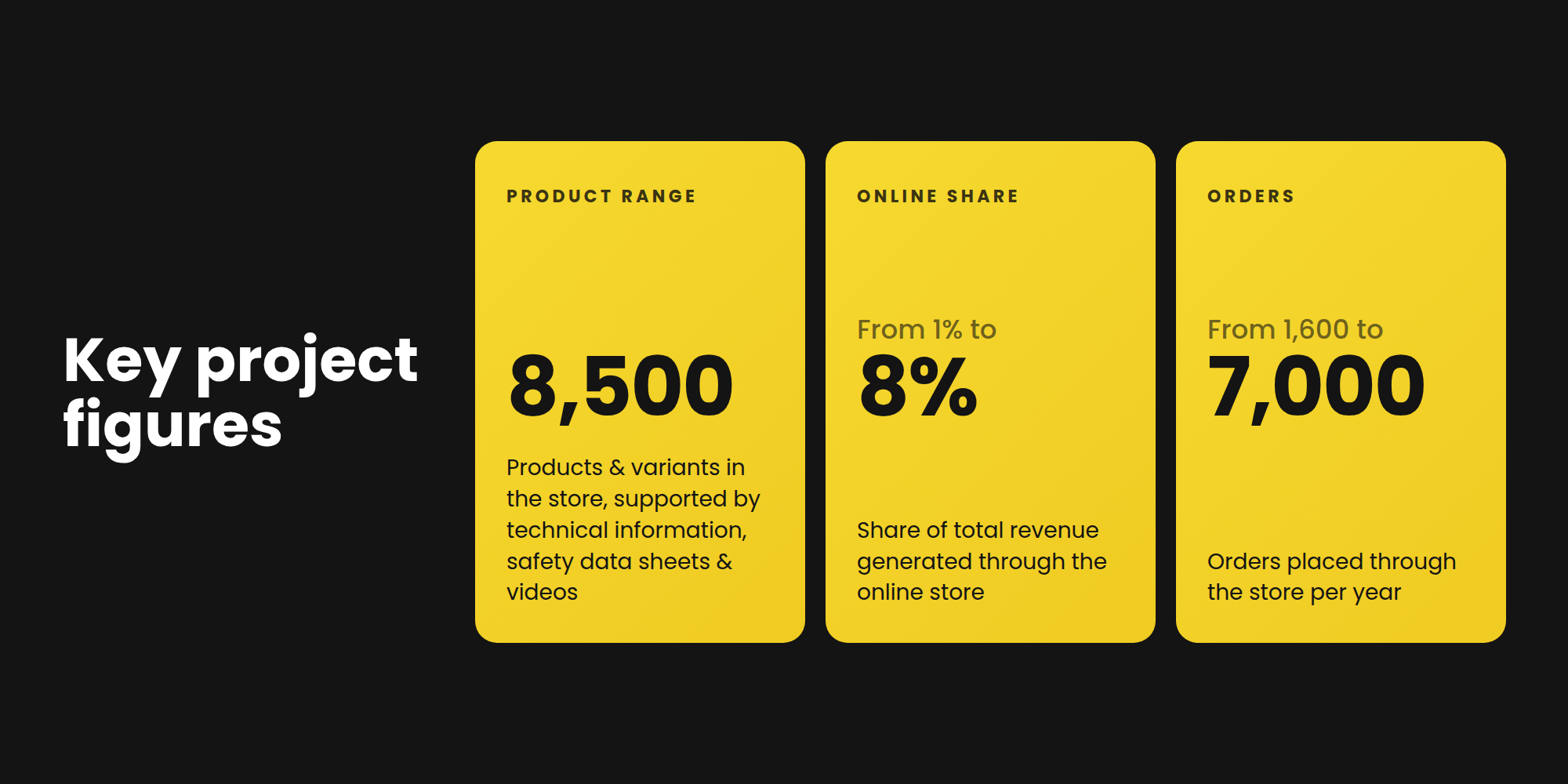
Finally, the hard numbers show just how much the online shop's importance has grown. At the relaunch in 2020, digital sales accounted for a mere one per cent of J. König's total revenue. Today, the figure is around eight per cent. A platform that barely registered commercially has become a sales channel that now generates almost one in every ten euros the company earns.
The development is even more striking when it comes to orders. In 2020, around 1,600 orders came in through the shop; in 2025, the figure was already close to 7,000. The number of orders has more than quadrupled in five years.
All of this is far more than a token success. The data doesn't simply show that the new shop works; it shows that it has been embraced. By customers who handle their orders on their own, and by employees who now make the digital channel a natural part of their day-to-day sales work.
Final thoughts: three tips from J. König for a successful digital transformation
And that would pretty much be everything. Or almost. Because if the J. König project shows one thing, it's that a successful digital transformation doesn't end with the launch of a new platform. So we asked Anatol Menke about his own key takeaways from the project. Three points matter most to him:
1. Choose your partners with the big picture in mind
A digital project is about more than just code. Technology, design, user experience and business requirements all have to work together. That's why, when selecting partners, it's important to look not only at individual capabilities, but also at whether the overall picture fits and whether everyone involved can work together constructively.
2. Communication matters as much as technology
Of course, employees need to be brought on board too, especially when established workflows are changing. But for that to succeed, an agency has to bring more to the table than technical know-how. Transparent communication, close alignment with everyone involved and a solution-oriented approach to problems are at least as important. In a project of this scale, friction can hardly be avoided entirely. What matters is how you deal with it.
3. Digitalisation takes time
Launching a new platform doesn't complete a digital transformation. Employees need to understand new ways of working, and customers need to get to know the new channel and experience its benefits. Those who guide this process and keep developing it consistently lay the foundation for the investment to pay off in the long run.
Your digital path to your customers
Above all, the project shows one thing: digital transformation in B2B doesn't mean throwing proven sales channels overboard. It means complementing existing processes with future-ready tools. Lasting change only works when you work with your people, not against them.
To see how digital solutions like these can be put into practice at other companies, take a look at our other Shopware projects. There you'll find more examples of how we develop tailored commerce solutions and take existing sales models into the digital age.
However different the requirements of individual companies may be, it's never about reinventing digital sales from scratch. It's about developing the right solution for an existing business model. That's why we support you end to end: from strategy and concept through design and development to systems integration and continuous optimisation. Find out more in our services overview.
It's been quite a journey from the first hand axe to the digital shopping basket, but no one said your own digital revolution can't start right now.
Technology
This project is built with our technology partners:


