hy was IT already so widespread in companies before the internet even existed?
At first glance, this question seems almost trivial. After all, it is obviously much more efficient to type a business letter on a PC than on a typewriter. But did a corporation such as Volkswagen AG still handle its entire ordering process by phone in the 1970s?
In fact, it did not. Even back then, computers around the world were able to communicate with each other. Data was transmitted via telephone lines to massive mainframes so that recipients could retrieve it later—once a day and at a speed that would probably drive us to loud outbursts of frustration today.
While that may sound archaic, it led to a technology that remains relevant to this day: the standardized exchange of data between companies, known in technical terms as Electronic Data Interchange (EDI).
In this article, we take a closer look at EDI: Why is a technology from the IT Stone Age still relevant today? What benefits can your company gain from Electronic Data Interchange? And where does Shopware fit into the picture?
But first, let’s start with the basics and answer the question:
EDI – What Exactly Is It?
The definition: Electronic Data Interchange (EDI) refers to the standardized, automated exchange of business documents between companies directly from one system to another.
So far, nothing particularly spectacular. It sounds very much like what computer systems do all the time anyway: exchange data. So does moving a photo from your camera app to your messaging app already count as EDI? Not quite, as a closer look at the definition reveals:
Standardized
For two systems to communicate with each other, they must speak the same language. This is why formats that are still used today were established as early as the 1970s: ANSI was developed in the United States, while Europe adopted EDIFACT. Today, EDI files are often based on XML.
Most importantly, once two companies have agreed on an EDI format, they can exchange data without requiring additional complex adjustments.
Automated
Communication between systems also takes place largely without human intervention. For example, your ERP system detects that inventory has fallen below a critical threshold. It generates a purchase order and sends it to your supplier’s system. The supplier’s system then creates the order and the corresponding e-invoice, which is sent back to you. Your IT system recognizes the payment request and initiates the corresponding banking transaction.
Of course, the human factor always enters the process sooner or later. Someone has to set up all these automations, and you will probably want to review the invoice before approving it. Nevertheless, EDI eliminates numerous manual tasks that would otherwise have to be completed by hand.
Business Documents
EDI was developed for business IT processes. Accordingly, it can handle virtually any document that is part of day-to-day business operations. Examples include:
- Purchase orders
- Invoices
- Order confirmations
- Delivery notes
- Shipping notifications
- Inventory reports
The only requirement is that the document can be converted into a standardized file format that the target system can understand and process. Birthday greetings for your business partners, however, will still need to be sent personally.
EDI Without Exception: The Mandatory E-Invoice
If you're thinking, “That’s just something for tech enthusiasts. We don’t need EDI,” unfortunately, that’s not the case. As you probably know, the countdown to mandatory e-invoicing is already underway.
As a reminder: Traditional invoices in a business environment are currently only permitted if both parties agree to them. By the end of 2027, all companies with annual revenue exceeding €800,000 in the previous year must switch to e-invoicing. Starting in 2028, all B2B transactions may only be invoiced in digital format.
The e-invoice is EDI in its purest form: a standardized, automated, machine-readable business document. In other words, some degree of EDI is definitely coming your way. Perhaps not on a large scale, but it is unavoidable if you want to continue issuing and paying invoices.
That said, if it is becoming mandatory anyway, it may be worth thinking about EDI on a broader scale right from the start...
Benefits: What Advantages Does EDI Bring to E-Commerce?
Of course, EDI is not just a compliance requirement for e-invoicing. It also offers a wide range of benefits. Otherwise, nobody would use it voluntarily. When we talk about benefits, we mean things like:
1. Massive Reduction in Manual Work
The advantage is obvious: when machines can communicate directly with each other, significantly less manual work is required. Without EDI, orders arrive via email, need to be entered manually, and transferred into the ERP system. If your customers’ or suppliers’ systems can communicate directly with your own, you can leave copy-and-paste behind.
2. Fewer Errors in Orders and Data
Manual work always comes with the risk of human error: a transposed digit here, an overlooked column there, a plus instead of a minus on the calculator. With EDI, these and similar mistakes are eliminated because all information is transferred directly to where it is needed.
3. Faster Processing Times
Machines are, of course, much faster than humans. Order processing is no longer measured in hours but in milliseconds. Orders are dispatched faster, required goods arrive sooner, and your business becomes more efficient overall.
4. Scalability Without Linear Personnel Growth
Another important point: an EDI environment can be scaled virtually without limits, without requiring additional staff. After all, it makes little difference to a machine whether a customer orders 50 or 500 different items. The time difference in processing is barely measurable.
5. Professionalization of the Entire Business
There are two aspects to this.
First, it simply appears far more professional if you no longer have to tell a business partner, “Please send me a fax,” but can instead connect their systems directly to your IT landscape via EDI.
Second, the first four benefits provide your team with a significant amount of time savings. You could use that opportunity to reduce staffing levels—or take the path chosen by smart merchants: invest that newly gained time in activities that drive growth. Outstanding customer service, in-depth analysis, intelligent product development. More time always means more opportunities to differentiate yourself from competitors and present your business as the kind of partner you would choose yourself.
System Question: Which Companies Benefit from EDI?
Standardized data exchange certainly sounds like a worthwhile investment. However, not every company benefits from EDI. Its implementation makes sense if...
...your order volume is large enough
As long as the number of orders you receive remains manageable, you can do without EDI. It does not matter whether your business is still growing or whether you operate in an industry that naturally involves relatively few but very high-value orders. If, on the other hand, your team is struggling to keep up with thousands of incoming orders, EDI can provide significant relief.
...you operate as a B2B merchant within wholesale structures
EDI was originally developed for wholesale businesses, and this is still very apparent today. Many business partners simply expect their systems to be able to communicate directly with yours. The more professionally organized they are, the stronger this expectation becomes. If EDI is not an option in your company, you may often find yourself left with only the least attractive business opportunities.
...you sell standardized products
Ideally, your product portfolio should consist of self-explanatory items that can be easily understood and ordered by a computer system. DIN-standard screws, clothing in standard sizes and colors, or typical office supplies are all suitable examples.
However, if you sell individually manufactured 3D-printed components, custom-made wedding dresses, or personalized fountain pens, EDI quickly reaches its limits. In these cases, an order often requires detailed consultation and guidance—something a machine simply cannot provide.
...your company suffers from too many media disruptions
One order arrives via email, another through WhatsApp, and a third customer has created their own Excel spreadsheet. While your team manually transfers all this information into your system, one error follows another.
If customer complaints are increasing and your biggest cost factor is called "data entry errors," it may be time to seriously consider EDI.
EDI and Shopware: Where the Actual Integration Layer Resides
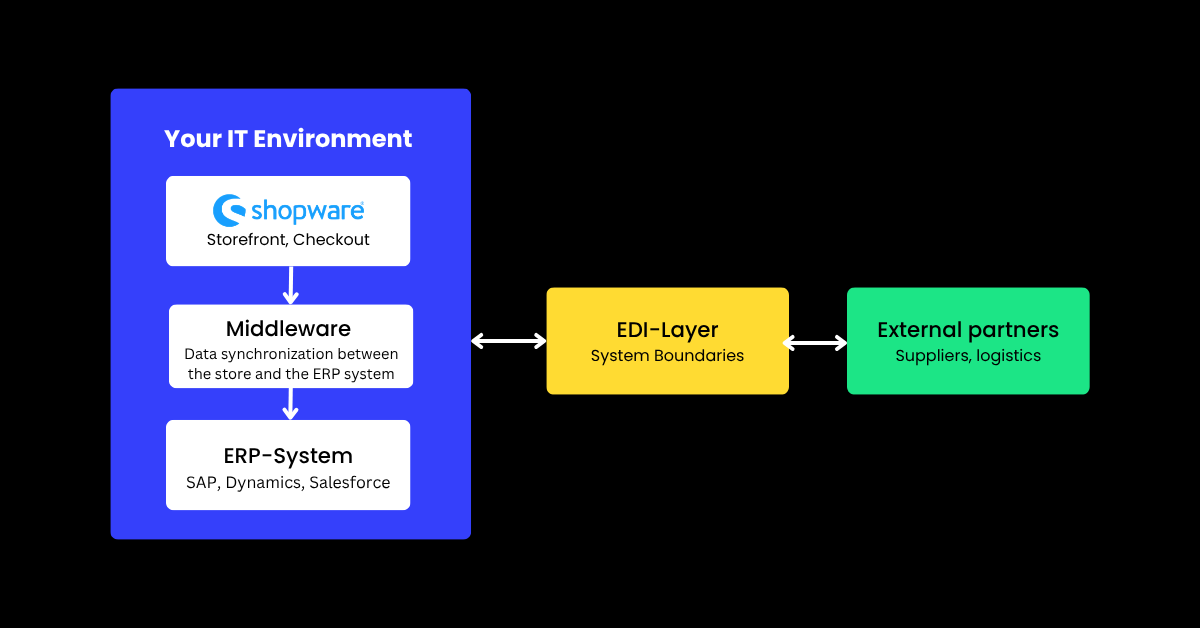
So how does EDI work with Shopware? To understand that, we first need to clear up a common misconception: When people talk about EDI in the context of Shopware, it often sounds as though EDI is simply a feature that can be added to the store.
However, in reality, Shopware is not responsible for the EDI solution. Your store is the place where commerce happens; essentially a storefront for the ERP system operating behind it. The real complexity begins only after that.
Shopware as the Starting Point, Not an EDI System
Let’s start at the beginning: Shopware is designed to manage sales, display products, process shopping carts, receive orders, and guide customers through the purchasing process. Once the final click has been made at checkout, the shop’s job is essentially done. Only then does the operational processing of the order begin—and this is exactly where EDI becomes relevant.
The Typical System Landscape in Mid-Sized Businesses
In practice, the system landscape in many mid-sized companies usually looks like this: Shopware merely generates the order. An ERP system (such as SAP, MS Dynamics, or Salesforce) handles all commercial processing. A middleware layer ensures that data is transferred correctly between the shop and the ERP system—so we are still not talking about EDI at this point.
Recommended reading: Speaking of ERP systems: How can Shopware be integrated with MS Navision? And what challenges can you expect when dealing with a legacy system? We explain it all.
Only in the next step does Electronic Data Interchange come into play—namely at the interface to everything that exists beyond your own system landscape, such as suppliers, major customers, or logistics providers.
In other words: EDI does not sit within the shop itself, but at its boundary with the outside world.
The Role of the EDI Layer
This is where EDI gets to work. It translates data from your internal system environment into standardized formats that your external partners can process, while also ensuring that incoming data can be understood by your own systems.
This translation capability is the true core of EDI in a modern setup. It is less about a single system and more about enabling heterogeneous system landscapes to communicate with one another.
And Why Is That?
Because it is important to remember that EDI has deep roots in supply chain management and is significantly older than the very first online shop. That is why it operates where relevant business data flows and commercial processes take place. Your shop is merely the entry point, not the entire process logic.
There is another reason as well: EDI is rarely a single, universal standard across all partners. Every major trading partner, logistics network, and ERP system comes with its own requirements. If you tried to map all of that directly within your shop, the complexity would quickly become unmanageable.
A Quick Note on: OCI PunchOut vs. EDI
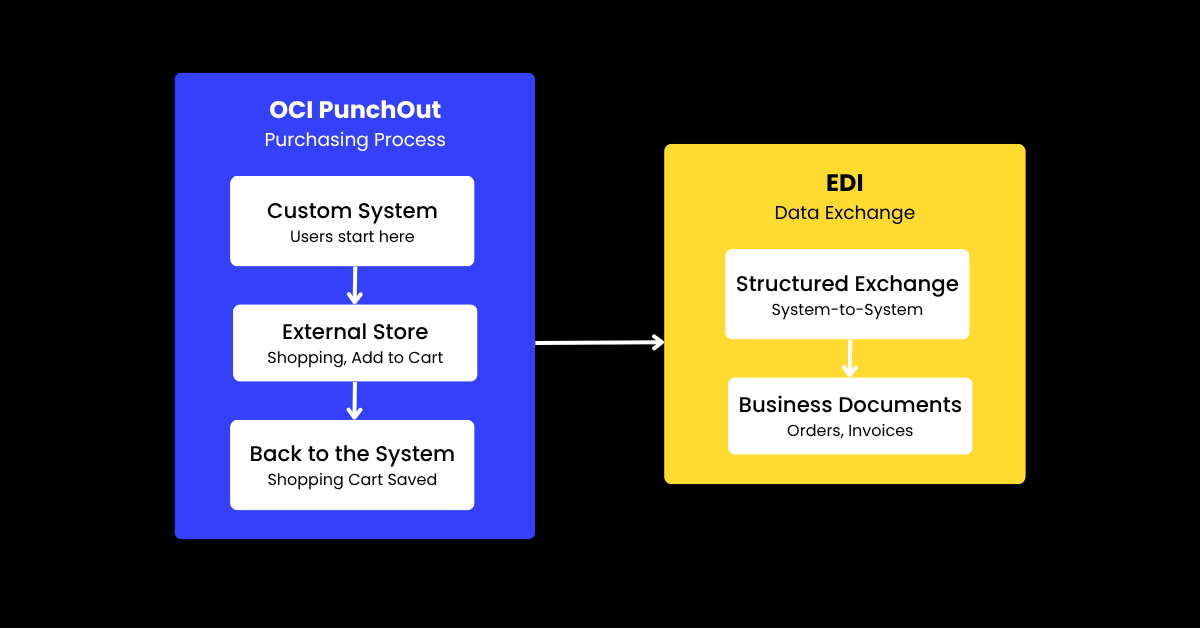
Finally, there is one small point we would like to address: Far too often, OCI PunchOut and EDI are treated as the same thing in the B2B world, even though they actually solve two completely different problems.
As mentioned several times already, EDI is the automated exchange of business documents between different systems. OCI PunchOut, on the other hand, is not a data exchange mechanism but a procurement process: A user starts within their own system, briefly leaves it to shop in an external online store, and then transfers the shopping cart back into their own system.
OCI PunchOut therefore comes before EDI in the process. Only after the purchase has been completed does Electronic Data Interchange take over, ensuring the structured exchange of the business data generated during the shopping process between the involved systems.
EDI: Our Final Thoughts
Although it is almost as old as the first personal computers, EDI remains a powerful tool in modern IT. It enables the fast and error-free exchange of business data between different systems and therefore plays a role in our connected world whose importance should not be underestimated.
There are, however, two things EDI is not.
First, it is not suitable for every company. To benefit from Electronic Data Interchange, you need a sufficiently large order volume and complex system structures.
Second, it is not simply another component of your Shopware store. EDI does not reside within the shop itself but where your IT landscape communicates with the outside world. In other words, EDI is not something you can simply switch on overnight; implementing it is always a process that requires considerable effort.
Preparing your Shopware store for EDI is, of course, one of the services we offer. If you would like to learn more about what else we can do for you, simply take a look at our services.
If you are interested in seeing what we have already implemented, visit our Shopware partner page. There, you will find an overview of our projects involving the platform. Whether EDI was part of those projects? We'd be happy to tell you. Just get in touch.
And by the way: those mainframes from the 1970s that we mentioned in the introduction are still quietly humming along today. So the next time your internet connection slows down, your provider may not necessarily be the one to blame.
FAQ: EDI for E-Commerce with Shopware
What is Electronic Data Interchange (EDI) and how does it work?
EDI is the standardized, automated exchange of business documents (such as purchase orders, invoices, or delivery notes) directly between two IT systems. Both systems speak the same language (e.g. EDIFACT or XML), allowing data to be transmitted and processed without human intervention.
What specific benefits does EDI offer my company?
EDI significantly reduces manual work and the errors associated with it, accelerates processing times from hours to milliseconds, and enables business growth without proportional increases in staffing. In addition, an EDI-enabled company appears more professional to business partners, which is increasingly becoming an expectation, particularly in B2B environments.
Is EDI worthwhile for every company?
No. EDI is particularly beneficial when order volumes are high, teams are struggling with fragmented communication channels and manual data transfers, or wholesale partners expect direct system integration. Companies with only a small number of orders or highly customized products—such as made-to-order goods—generally benefit much less from EDI.
Is EDI a feature that I can simply activate in my Shopware store?
No, this is a common misconception. Shopware is responsible for the sales process. EDI comes into play only afterward, at the interface between your internal IT landscape and external partners such as suppliers or logistics providers. In most cases, there is also an ERP system and a middleware layer involved. As a result, implementing EDI is always a complex project rather than a simple configuration setting.
What is the difference between EDI and OCI PunchOut?
These two terms are often confused in the B2B world, but they solve different problems. OCI PunchOut describes a procurement process: a user temporarily leaves their own system, makes a purchase in an external online shop, and then transfers the shopping cart back into their original system. EDI only takes over afterward, handling the structured exchange of the business data generated during that purchasing process between the participating systems.