o give you a feel for the topic of this article, we would like to start with a very real-life scene: imagine you enter an electronics store to buy a charging cable for your mobile phone. You quickly find the shelf labeled in large letters “Cables,” a second glance and you also discover the “Chargers.” But then…
What exactly is the difference between USB 2.0, USB 3.2, and USB4? Why doesn’t the packaging say whether the cable can also transfer data? What on earth do PD and EPR mean? And how many watts does such a cable need to support the quick charge function? Desperately, you look around for a salesperson, but they are apparently on a break.
What we are describing here can be perfectly transferred to e-commerce: the path to the correct aisle is analogous to the navigation bar in a store. The sales advisor would correspond to an intelligent search function, which in far too many shops is still completely neglected.
That is exactly why the following lines will show you how it can be done better, because together with our CTO Yann Karl, we take a deep dive into the Shopware and Nosto setup: What sets the Commerce Experience Platform (CXP) apart from other search systems? What do you need to pay attention to in order to get the maximum value from the tool? And where are the typical mistakes when working with the software hidden?
Before we go into the details, however, we should clarify the basics. For example:
Nosto – What is it and what does it have to do with Shopware?
The company Nosto was founded in Finland in 2013. Its product: a search tool for online stores that does not simply process the parameters of a search query, but instead proactively provides recommendations and personalizes displayed content based on user behavior and interests. At its core is the idea of turning anonymous shop traffic into a personalized shopping experience.
Together with Shopware, a strategic partnership was announced in 2025 and the AI-powered search solution “Deep Search powered by Nosto” was developed. In this setup, Nosto technology is directly integrated into Shopware to not only improve search results, but to dynamically adapt them to the intention and interest of visitors, thereby improving conversions.
Nosto in practice: How does it differ from a standard search?
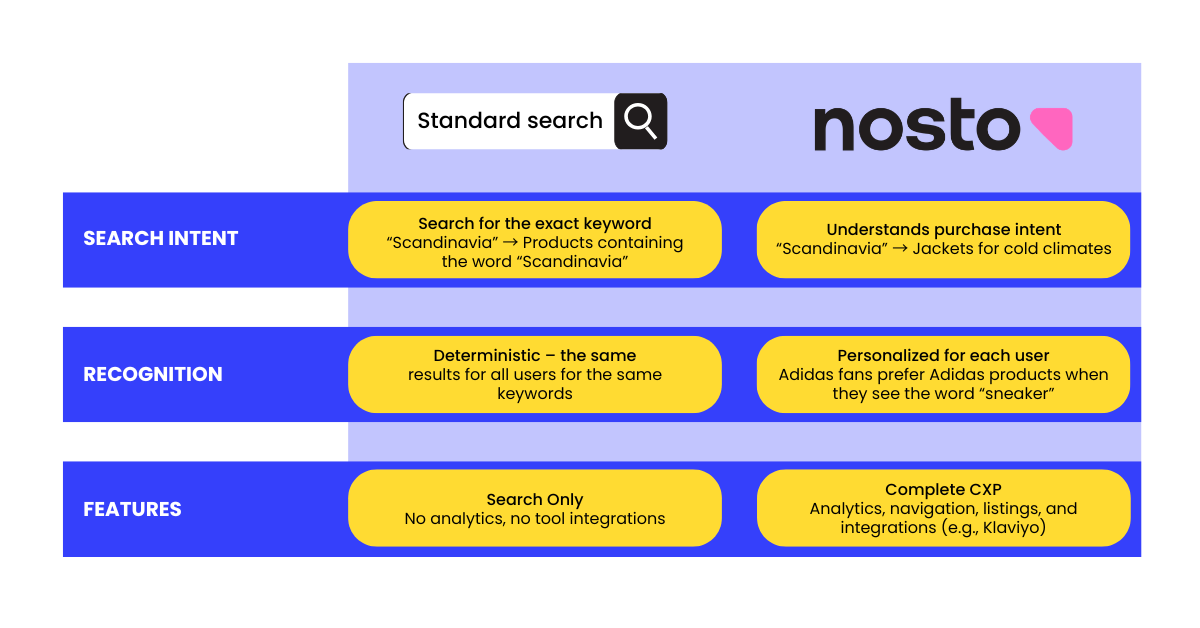
But enough marketing talk. If this still sounds too theoretical, we fully understand. To give you a concrete impression of how Nosto works in practice, we will give you three examples:
1. Nosto understands search intent
Traditional search tools process keywords or rely on an index. Nosto, on the other hand, understands (after a learning phase) what customers actually intend with their search. If a visitor enters “hiking jacket for Scandinavia,” a conventional tool searches product detail pages for the term “Scandinavia.” Nosto, however, understands that the user is looking for a jacket for cold climates and adjusts the results accordingly.
2. Nosto recognizes returning customers
A standard search engine outputs results deterministically. This means that if two different users enter the same keywords, the displayed products are always identical. Nosto, however, remembers customer preferences (via session behavior, cookies, or user accounts—always ensure consent and data privacy compliance). If a customer has previously only bought Adidas sneakers, they will preferentially see products from their favorite brand when searching for something like “blue sneakers.”
3. Nosto is a full CXP
Nosto is not limited to search queries. As a Customer Experience Platform, it also offers extensive analytics capabilities and can be integrated with other tools. For example: Nosto and the marketing platform Klaviyo can be tightly integrated. If Adidas launches a new collection, Nosto remembers our sneaker customer from earlier and informs Klaviyo to notify her via newsletter about the offer.
Nosto x Shopware: Is such a search tool even worth it?
At this point you are probably thinking: “This all sounds great on paper, but it also sounds like effort and investment. Is all that really necessary?”
Our answer is a clear yes, because the numbers underline how important search functionality is in a Shopware store. Studies (including from Opensend and Findbar) have shown:
.png)
30–40% of all visitors use the search in a shop. That may not sound impressive at first, but:
Users who use search convert two to three times more often than visitors who only browse. Anyone entering keywords already has a concrete purchase intent.
At the same time, 15–24% of all search queries return no results—mainly because AI has changed user behavior. Users are now trained to ask questions rather than enter keywords.
In short: the search function of a store is simultaneously one of the biggest revenue drivers and one of the biggest revenue killers in e-commerce.
Shopware + Nosto: Which stores benefit from this combination?
Before you now go knocking on your trusted agency’s door asking why Nosto has not been implemented in your store yet, a few important notes. To actually benefit from the CXP and not just install an expensive standard search, a few conditions need to be met:
1. Sufficient number of SKUs
Nosto only becomes meaningful when you offer a sufficiently large product portfolio. A shop where the entire catalog fits on one page does not need a CXP. A few hundred SKUs should be the minimum. The more similar the products are (fashion, electronics, furniture, etc.), the more you benefit.
2. Enough traffic
Nosto is a learning system, but to learn it needs data. That data only exists if users actually visit your store. Plan for tens of thousands of sessions per month. Only then does the tool have enough information.
3. The right funnel
If your marketing funnel is designed so that users land directly on the correct product detail page from search engines, you don’t necessarily need an intelligent search. But if users enter your store primarily via homepage or landing pages, search becomes especially important.
4. High-quality product detail pages (PDPs)
Finally, Nosto must not only understand search queries but also be able to map them to results. This only works if every PDP provides sufficient information. If your products are only labeled “socks, black” two hundred times, even the smartest AI is powerless.
Shopware + Nosto: How long is the time to market?
Your store is suitable for Nosto and you are now considering implementing it? Then your next question is probably: “How long does it take to get Nosto up and running, and will my shop go offline during implementation?”
Nosto can be implemented in Shopware 6 relatively easily. Setup can be done within a day without disrupting store operations—however, this is the best-case scenario.
If additional external tools are running in your store, conflicts may arise. This is not a Nosto problem per se, but rather due to how Shopware 6 works: every tool can potentially access every part of the platform. If permissions and resource handling are not implemented cleanly, one tool may tell another: “Hands off, that’s my data!”
In a mid-sized shop where multiple systems are typically involved, setup therefore requires care and control. Expect an implementation time of three to four days.
Typical mistakes when using Nosto
.png)
Nosto has been installed in your store, tested, and handed over to you? Then here is what you should not do:
Not continuing to optimize Nosto
Nosto is not a fire-and-forget tool. On the contrary: like your website content, it must be continuously adjusted and optimized. Recommendations need refinement, and customer segments need ongoing improvement.
Only analyzing conversions
Yes, conversions are important. But treating them as the sole metric is too narrow. Nosto allows you to track the entire customer journey: what a customer views before adding an item to the cart, where they abandon their purchase, and what they were doing at that moment. These insights are often more valuable than just more sales.
Using Nosto only for search
To generate meaningful insights, Nosto needs data. If you only use it for search, your dataset remains incomplete. You should also run navigation and listing through Nosto to avoid skewed recommendations.
Overusing it
On the other hand: too much Nosto is also a mistake. Too many pop-ups, newsletter prompts, and “frequently bought together” elements before, during, and after checkout can overwhelm users. Recommendations are good—advertising can become annoying.
Shopware and Nosto: Top use cases
To close this article, here are the most important use cases you should cover with your Nosto setup:
Synchronizing advertising across channels with on-site experience
Have you ever seen a huge promotion in a flyer, rush to the website, and find nothing there? That is extremely frustrating for customers.
Nosto helps prevent this by synchronizing external campaigns and dynamically placing promoted products directly on landing pages.
Considering brand affinity of returning customers
Once Nosto has learned customer preferences, it uses them in recommendations. A fan of French red wine will not be shown Californian white wine. This improves conversion rates and strengthens trust.
Post-purchase and after-sales marketing
Nosto can work closely with Klaviyo. This enables automated lifecycle messaging—care tips after a purchase, fitness check-ins after running shoes, and more. This strengthens customer loyalty and enables cross-selling.
Deep Search powered by Nosto: also an option for your Shopware store
And with that, we are at the end of this article. You now know what Nosto is, how it differs from other search tools, who it is suitable for, and what the most common mistakes and best use cases are.
If you now believe that Nosto is the right solution for your Shopware store, feel free to learn more about our services around the Shopware ecosystem and get in touch.
If you would first like to see more examples of what we have already built for other Shopware stores, we are happy to share those insights as well.
In any case, we look forward to your inquiry—and we can already guarantee you: unlike the salesperson from the introduction, we definitely won’t hide from your questions.
FAQ: Shopware x Nosto
What is Nosto and what does it bring to e-commerce?
Nosto is an AI-powered Commerce Experience Platform (CXP) that personalizes search results and product recommendations. Instead of just matching keywords, it analyzes user behavior and understands search intent, improving relevance, conversion rates, and revenue.
Which shops benefit from Nosto?
Nosto is especially valuable for online stores with large assortments, sufficient traffic, and complex purchase decisions—particularly in fashion or electronics.
How long does Nosto integration into Shopware take?
Integration typically takes about one day in the best case. In more complex setups, three to four days should be expected. Store operations are usually not disrupted.
Do I need to maintain Nosto after setup?
Yes. Nosto requires ongoing optimization, including analytics review and refinement of recommendations and segmentation.
What are the most common mistakes?
Common mistakes include underuse (only search), overuse (too many recommendations), and focusing solely on conversions instead of the full customer journey.