rom 19 June 2026, every webshop that sells products, services or digital content to consumers in the EU must offer an electronic withdrawal function, commonly known as the "withdrawal button". The legislator's premise is simple: cancelling a purchase should be just as easy as making one. Below we set out what's changing and what it means for your shop.
What exactly is changing?
The right of withdrawal itself isn't new. Consumers have had a cooling-off period of at least fourteen days for most online purchases for years. What's changing is how a customer must be able to exercise that right. A hidden link in the terms and conditions, an email to customer service or a PDF form will no longer suffice.
The obligation stems from Directive (EU) 2023/2673, which amends the European Consumer Rights Directive. The 19 June 2026 deadline applies across all EU member states, with no transition period. It doesn't matter where your business is based: as soon as you target EU consumers, you fall under it.
What does the function need to meet?
The button must be clearly visible and easy to find, and remain available throughout the entire withdrawal period. The law prescribes a two-step mechanism:
- The customer uses the function to indicate they want to withdraw from the contract, providing their name, order details and contact details.
- The customer confirms this via a clearly labelled confirmation step.
After that, you're obliged to acknowledge receipt straight away - for example in an email stating the content, date and time of the request.
Not everything falls under it. There is no statutory right of withdrawal for bespoke goods, perishable goods and sealed hygiene products, so the button doesn't apply to those either. If you sell exclusively B2B, you're exempt; for mixed models, the moment consumers can also buy from you is what counts.
The button is the tip of the iceberg
A click on the withdrawal button is a formal, legal withdrawal request. That means the processes behind it need to be in order:
- automatic confirmation to the customer
- an internal workflow that links the request to the right order
- routing through to your returns and refund process
- updating the order status
- recording and retaining documentation for compliance
So don't treat the button as a standalone link, but as a new entry point into your entire post-purchase experience.
What if you're not ready in time?
The risks are significant:
- Fines that in some member states can run up to 4% of annual turnover. In the Netherlands, the ACM (Authority for Consumers & Markets) is the supervisory body.
- An extension of the cooling-off period from fourteen days to a maximum of twelve months and fourteen days; customers can then still withdraw up to well over a year after purchase.
- Loss of customer trust, as difficult cancellations are increasingly held against you.
What does this mean for your platform?
On our partners' platforms there are now solid routes to a compliant withdrawal function. Which one fits best depends on your setup.
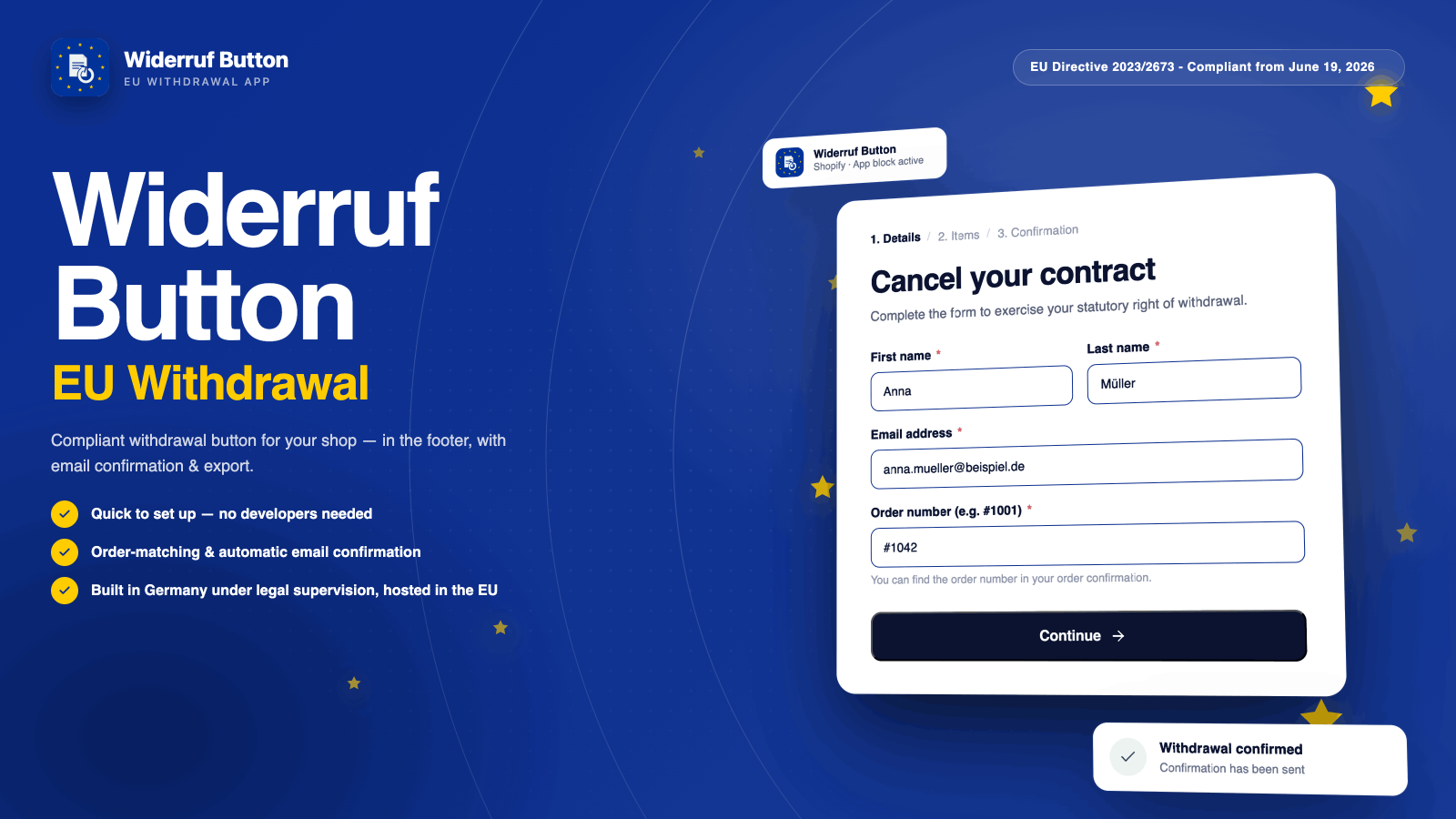
Shopify merchants have several options. Our colleagues at Eshop Guide, part of Strix Group, developed the EU Withdrawal Button app, which lets you easily add and manage a compliant withdrawal function. Shopify also offers a native EU Right of Withdrawal feature; this does require you to be on New Customer Accounts and self-serve returns, so if you're still on legacy customer accounts, a migration is part of the picture.
Shopware merchants are well covered too, thanks to the platform's flexibility: the withdrawal function can be integrated cleanly into the existing customer journey and checkout, and connects seamlessly to your own returns and refund processes. Whether that's via a plugin or custom work is something we determine based on your current setup, that way you keep full control over the experience and the data.
How Strix helps
We've already been helping our clients with this change. We don't see it as a compliance checkbox, but as an opportunity to improve your post-purchase experience. Strix helps you map your current customer journey, set up a compliant withdrawal function and automate the processes behind it, on each platform it concerns.
Want to know more about the impact? Get in touch with us. We're happy to help you understand the impact on your platform, processes and customer journey.
(Source: Commission.Europa.eu)