S+S Regeltechnik: Shopify as the Foundation for Demanding Industrial Commerce
.png)
About
Complex B2B processes on Shopify? Our S+S Regeltechnik case study shows why structured data and automation make all the difference. Read it now.
Challenge
About
S+S Regeltechnik develops and manufactures sensors as well as measurement and control technology for building automation and mechanical engineering. Its range covers solutions for temperature, humidity, pressure, air quality and other measured variables, along with custom developments for a wide variety of applications. With a broad and technically demanding product portfolio, the company serves specifying engineers, plant builders, system integrators, installers and other B2B customers who rely on precise product information and solutions tailored to their exact needs.
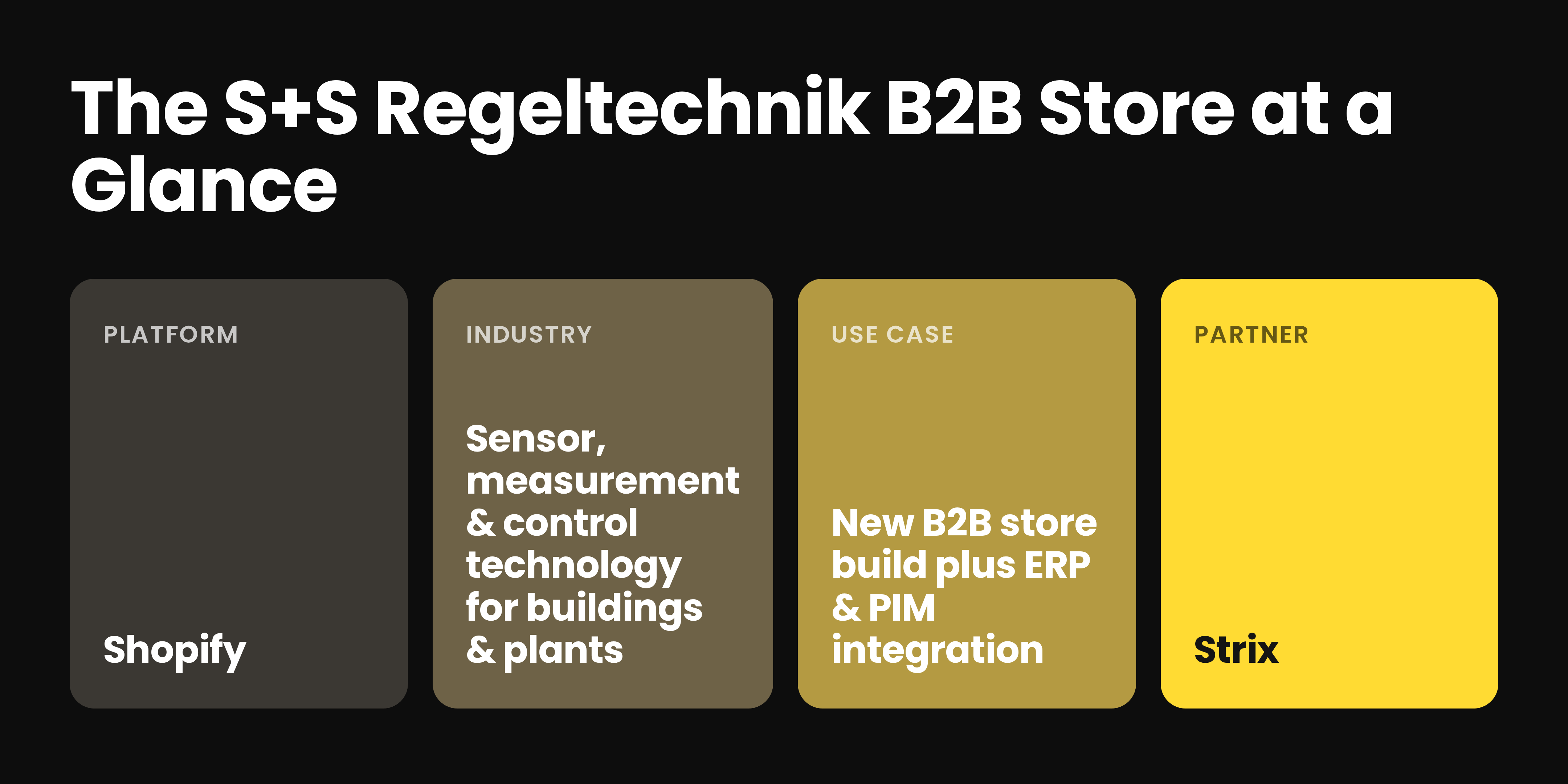
The S+S Regeltechnik B2B Store at a Glance
Challenge
“We're not heating the great outdoors!” Ever heard that one? Almost certainly, because those few words are basically the codified go-to line for: the heating or AC is running and yet someone has left the window wide open.
So far, so familiar. But who actually makes sure the temperature is right inside an airport terminal? Who measures whether the air quality in an office building is up to scratch, or whether machines in a production plant are running under the right conditions? And has the manager of a shopping mall ever bellowed “We're not heating the great outdoors!” down the corridors?
Probably not, because what's at work here is precise sensor technology that captures the data used to control entire buildings or machine systems automatically. Reliably, invisibly and around the clock.
These are exactly the kinds of solutions S+S Regeltechnik develops. The company offers sensors and transmitters for a wide range of applications in building automation and mechanical engineering. But the more varied the use cases, the more demanding it becomes to represent that range digitally.
For a long time, S+S relied on a custom solution. The thinking behind it: complex product and sales structures need an equally complex solution to capture them in full. Until the company pulled the plug and migrated its e-commerce entirely to Shopify.
This case study reveals the story behind that move: Why don't even multi-layered B2B processes need a custom store? What role do data, automation and interfaces play? And why is Shopify's standardization such a massive advantage here?
Guiding us through it as the expert from S+S Regeltechnik is Maximilian Mößler, Team Lead E-Commerce.
The Starting Point: When Customization Becomes a Bottleneck
On the face of it, the logic seems sound: a technically demanding product range needs a custom-built shop to fully capture its processes and structures. That's why S+S Regeltechnik initially opted for a bespoke B2B store based on Microsoft Navision. The solution was tailored precisely to the company's specific requirements, but over time it became clear that this kind of custom architecture can set tight limits:
Even minor changes to the shop required outside help. Changing so much as a color in a product display inevitably meant raising a ticket with the agency in charge. Needless to say, this slowed internal processes to a snail's pace; driving content and further development forward on its own was barely an option for the S+S team.
On top of that came technical challenges: performance issues, error-prone processes and problems with core functions such as the checkout all undermined the shop's usability. That made the platform not only maintenance-heavy, but also user-unfriendly and hard to scale.
The switch to Microsoft Dynamics 365 Business Central ultimately provided the impetus to fundamentally rethink the e-commerce platform as well. What the company was looking for, though, was not another one-off solution, but a future-proof foundation that could combine stability, scalability and the particular demands of the B2B business.
Solution
Solution
The choice fell on a system that might not spring to mind straight away when it comes to demanding B2B projects: Shopify. After all, the platform is best known for its high-performance B2C stores. Reason enough to take a closer look at the details:
Why It Became Shopify
“We didn't choose Shopify because our business model is simple, but because the technical foundation is stable, scalable and comparatively low-maintenance.”
– Maximilian Mößler, Team Lead E-Commerce at S+S Regeltechnik
For S+S Regeltechnik, the decisive advantage of Shopify lay in being able to cover many requirements with the platform's existing capabilities. Extensions and custom code would only come into play where they create genuine added value.
Shopify offers exactly the right basis for this: technical product information can be structured through metafields, relevant attributes can be used for search and filtering, and extensive documents can be made available directly on the products. At the same time, international markets, multiple languages, business customer accounts as well as customer-specific prices and catalogs can all be integrated. Interfaces also establish the connection to Microsoft Dynamics 365 Business Central.
“We didn't choose Shopify because our business model is simple, but because the technical foundation is stable, scalable and comparatively low-maintenance,” Maximilian explains.
Independence in day-to-day operations was also important for S+S Regeltechnik. Whereas even minor changes previously required external support, the team can now manage content and further development far more independently on Shopify.
Why It Became Strix
“Our products and variant logic are highly specialized. That's why close collaboration was essential: we brought in our expertise, and Strix translated that knowledge into Shopify structures.”
– Maximilian Mößler, Team Lead E-Commerce at S+S Regeltechnik
As easy as Shopify is to work with day to day, building the store, connecting the ERP and PIM, and developing a consistent data model across all systems takes real IT expertise. Maximilian explains why S+S chose Strix like this:
“We were looking for a partner who not only builds an appealing frontend, but also understands Shopify, B2B commerce and complex system landscapes. It was also important to us that the requirements of an industrial company could be translated into a user-friendly shop structure. That exact package of experience and expertise is what we found at Strix.”
The Team Lead E-Commerce adds: “Throughout the project, Strix's communication skills were extremely helpful. Not just actively, but passively too: simply listening and understanding. Our products and variant logic are highly specialized. That's why close collaboration was essential, with us bringing in our knowledge of products, customers and processes, and Strix translating all of it into Shopify structures.”
But speaking of the project and product logic:
The Implementation
“B2B commerce is far more of a data and process project than a pure web design project.”
– Maximilian Mößler, Team Lead E-Commerce at S+S Regeltechnik
Don't worry, we won't bore you with the nitty-gritty details. Instead, we'll focus on the core areas that were decisive for the project's success: the structured product data foundation, the user-oriented presentation of the technical range, and the seamless integration into the existing system landscape at S+S Regeltechnik.
1. Data Foundation: A New Data Base for a Demanding Product Range
With a technical range like the one at S+S Regeltechnik, the challenge lies not in the number of products, but in the sheer variety of their attributes: measuring range, output signal, communication protocol, protection rating or housing design are just a few of the characteristics that can matter when making the right choice.
For customers to make meaningful use of this information in the shop, a consistent and structured data foundation is essential. That's why the new setup established the PIM as the central source for all product information. Product descriptions, technical attributes, images and documents are maintained there, then processed automatically via n8n and made available in Shopify metafields.
This structure creates the basis for powerful search and filter functions and makes it possible to represent technical differences between products in an understandable way. At the same time, consistent terminology ensures that information can be processed reliably across systems, an important prerequisite for automation and the long-term development of the shop.
2. Self-Service: From Digital Catalog to Technical Guidance
What's more, a product search in an industrial setting rarely starts with an article number. Far more often, customers reach the right result via a technical requirement: Which measured variable is needed? What application is the sensor intended for? Which interface or output signal is required?
This is exactly the search approach that the new S+S Regeltechnik shop reflects. Customers can search specifically for products they already know, but they can also be guided to the right item via applications, product families and technical attributes. Structured filters help narrow down the selection based on relevant characteristics such as measuring range, communication type or design.
The product pages were also designed to support technical decisions: key attributes are shown directly, while more extensive documents such as data sheets, operating manuals, declarations of conformity, and CAD and BIM data are available for download on every PDP.
This makes the online shop far more than a digital catalog to leaf through. Customers are actively supported in finding the right solution for their specific use case – regardless of whether they already know the article number or first need to get their bearings within the range.
3. B2B Commerce: Companies, Prices and Catalogs
Of course, personalization in B2B commerce doesn't end with product selection. Whereas a classic online shop shows all users the same products and prices, business customers often work with individual terms, assortments and access rights.
That's why the new S+S Regeltechnik Shopify store maps companies and company locations in a structured way. Contacts can be assigned to their respective location via their email address and enabled for the B2B area. Customer-specific prices and catalogs are transferred automatically from the internal systems and are immediately available to the relevant business customers.
In this way, the shop combines a modern self-service experience with the demands of individual business relationships, without every order having to be handled manually through sales or customer service.
4. Integration: Shopify as Part of the System Landscape
Finally, a modern B2B shop of course never replaces a company's existing systems; it connects them in a meaningful way. At S+S Regeltechnik, too, Shopify therefore doesn't take on the role of an ERP or PIM system, but acts as a customer-oriented shop window into the world of products.
Commercial data such as prices, customer records and other business information continues to be managed in Microsoft Dynamics 365 Business Central. The PIM remains the central source for product information such as descriptions, technical attributes, images and documents.
Through integrations and automations with n8n, relevant information is exchanged between the systems. This includes, among other things, customer data, price updates, product information, orders and tracking information.
This clear division of responsibilities keeps the individual systems manageable and lets each play to its strengths: Business Central for commercial processes, the PIM for product data and Shopify for digital interaction with customers.
Results
Results
“The biggest step forward is the combination of commerce, technical information and self-service. Internally, we can publish content faster and automate more and more processes.”
– Maximilian Mößler, Team Lead E-Commerce at S+S Regeltechnik
With the new Shopify store, S+S Regeltechnik now has a digital commerce platform that fits the demands of a technically sophisticated B2B business far better than a cumbersome, barely manageable custom store.
And the biggest advance lies not in any single feature, but in the combination of structured data, automated processes and a platform that is far easier to develop further in-house.
The key benefits:
- More independence in day-to-day operations: Content, product information and further development can now be maintained and rolled out by the internal team far more easily, without relying on external support for every small change.
- Better orientation within the range: Customers find technical information and relevant documents clearly laid out in one central place. This lets them select products in a targeted, self-directed way based on their applications and attributes, taking pressure off sales and service.
- Fewer manual processes: By connecting Shopify with Business Central and the PIM, customer data, prices, product information and orders are exchanged automatically between the systems.
- A scalable foundation for growth: New markets, languages, products and digital services can be developed further on a stable platform, without having to build another custom one-off solution from scratch.
The new shop is therefore far more than just an ordering channel. What has emerged is a central platform for product information, guidance and digital support for business customers.
Learnings
“The crucial point is not to see Shopify as a finished, off-the-shelf solution, but as a stable platform on which the business logic is built cleanly.”
– Maximilian Mößler, Team Lead E-Commerce at S+S Regeltechnik
At the end of the project, though, there's not only a high-performance B2B store, but also some important insights that are relevant to plenty of other use cases. Perhaps yours, too:
- B2B commerce is above all a data and process project: A modern shop can only work as well as the quality of the product data, pricing logic and internal workflows behind it allows. For technically demanding ranges in particular, a clean data structure forms the basis for search, filtering, automation and a good customer experience.
- Not every requirement calls for a custom one-off solution: The best results often emerge where stable standard functions are used deliberately and only the truly specific requirements are extended. That keeps the platform maintainable and able to evolve over the long term.
- Complex business models don't need complicated platforms: What matters is not how many custom features a system has, but how well data, processes and user experience work together. A clear architecture creates room for growth and new requirements.
- Successful digitalization comes from shared know-how: Technology alone isn't enough. What's decisive is the combination of industry knowledge, internal processes and technical expertise. While S+S Regeltechnik brought in the requirements from its product world and business, we supported the translation into a scalable commerce structure.
Ready for the Next Level in B2B Commerce?
Our project with S+S Regeltechnik shows: even technically demanding industrial companies can build a powerful digital commerce platform with Shopify. What's decisive is not only the choice of shop system, but above all a well-thought-out data structure, clear processes and the combination of technological understanding and industry knowledge.
And Shopify is just one of several platforms on which we deliver B2B commerce projects. With Shopware, too, we develop custom solutions for companies that want to represent complex product portfolios, ERP connections and specific business processes digitally.
We also support companies along the entire commerce journey, from strategic consulting through UX and design to technical implementation, integration and ongoing optimization. The result is digital platforms that don't just work today, but can grow with the company's requirements.
If that sounds interesting to you, feel free to get in touch. And in the meeting, we won't complain if the AC is running while the window is wide open. We'll grit our teeth and bear it.
Technology
This project is built with our technology partners: